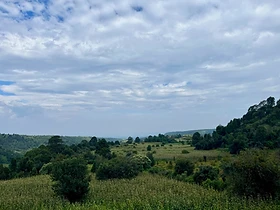
My teaching is rooted in an inclusive, dynamic, and experiential learning environment that inspires critical engagement with environmental anthropology, agroecology, sustainability, and biocultural diversity. Drawing from my interdisciplinary background and field experience across Latin America, Europe, and North America, I cultivate a space where intellectual curiosity thrives and learning extends beyond the classroom.
Experiential and field-based learning
Learning becomes meaningful when students actively engage with material through direct experience. In my courses, I integrate field-based learning, participatory research, and case studies to help students move beyond theory and develop a deeper understanding of social-ecological systems. In environmental anthropology, students explore traditional agricultural practices such as milpa farming by combining ethnographic fieldwork with agroecological analysis. Through hands-on activities — mapping crop rotations, interviewing local farmers, analyzing soil composition — students witness firsthand the complex interactions between human societies and the environment. Whether during a hike in the Andes, a visit to an agroforestry site, or a conversation over dinner in a rural homestay, I ensure that learning extends beyond the classroom walls.
Ethnographic inquiry
I encourage students to approach environmental questions through their ecological, cultural, historical, and political dimensions. Ethnographic observation, interviews, field notes, and participatory mapping are central to my pedagogy, giving students the tools to examine how knowledge is produced through sustained relationships with particular landscapes and communities. In my food systems courses, students conduct ethnographic observation of local markets, interviews with food producers, and participatory mapping exercises that reveal the socioecological connections among soil, labor, infrastructure, and culinary practice. This approach teaches students that environmental questions are never merely technical but are always entangled with culture, power, and history.
Collaborative learning
I view the classroom as a collaborative space where students are active participants in knowledge production. Rather than positioning myself as the sole source of knowledge, I facilitate critical discussions, encourage diverse perspectives, and support students in developing their own academic and professional identities. I design assignments that allow for creativity and self-direction — multimedia projects exploring environmental justice movements, policy briefs addressing sustainability challenges, ethnographic stories grounded in local knowledge. By allowing students to integrate personal interests and career aspirations into their coursework, I create opportunities for them to take ownership of their learning and develop the confidence to pursue independent inquiry.
Latin American and Global South perspectives
Having conducted research and taught in Latin America, Europe, and North America, I integrate diverse ethnographic case studies that challenge students to think beyond their cultural and disciplinary boundaries. By incorporating materials from Indigenous, Latin American, and Global South perspectives, I encourage students to critically examine environmental challenges through multiple lenses. In a discussion on climate change, I juxtapose ethnographic accounts of Andean water management with political ecology critiques of extractivism and policy analyses of transnational conservation. This interdisciplinary approach enables students to understand environmental issues not as isolated problems but as part of broader political, historical, and cultural processes. I also emphasize linguistic and cultural inclusivity, drawing on my experience teaching complex ecological concepts in Spanish in rural Bolivia.
Mentorship
I mentor undergraduate and graduate students working in environmental anthropology, agroecology, multispecies ethnography, food sovereignty, and related fields. Drawing on my ethnographic and collaborative research in Mexico, Bolivia, and Chile, I help students develop projects that are methodologically rigorous, ethically grounded, and attentive to the communities and landscapes in which their research is situated. I am especially committed to supporting first-generation students and scholars from historically underrepresented backgrounds. My approach to mentorship emphasizes careful listening, intellectual independence, methodological clarity, and sustained reflection on the responsibilities that accompany field-based research.
Courses
Courses taught
Courses I have taught at Universidad Iberoamericana and Babeș-Bolyai University, with pedagogical methods and selected assignments for each.
Sustainable Food Systems
Undergraduate
Universidad Iberoamericana 2023–present
Food studies, anthropology, and agroecology
This interdisciplinary course approaches food systems as socioecological assemblages connecting soil, water, labor, knowledge, infrastructure, markets, public policy, technology, culinary practice, and social inequality. Grounded in anthropology and agroecology, it examines how ecological, cultural, economic, and political forces shape the production, distribution, consumption, and disposal of food. Students use ethnographic observation, interviews, field notes, participatory mapping, comparative exercises, and local case studies to examine industrial, agroecological, urban, and community-based food systems. The course culminates in a small, context-sensitive intervention through which students apply what they have learned to questions of health, equity, and sustainability.
Pedagogical methods
Ethnographic observation of local markets and food sites, interviews with food producers, participatory mapping exercises, comparative analysis of food systems, and a final intervention project.
Selected assignments and field exercises
Ethnographic observation of a local market; interview with a food producer; participatory food system map; final intervention project addressing health, equity, or sustainability.
Syllabus available upon request
Agroecology and Society
Graduate seminar
Babeș-Bolyai University 2021–2022
Environmental social science
Agroecology is both a field of study and a set of practices shaped by ecology, geography, sociology, anthropology, Indigenous and campesino knowledge, and other intellectual traditions. This seminar examines agroecology as a response to the environmental, cultural, and political-economic crises produced by industrial food and agricultural systems. Students engage with foundational and contemporary scholarship from the social and natural sciences while examining struggles for more just and sustainable food systems. The course considers agroecology not only as a scientific approach, but also as a political project, social movement, and form of situated practice.
Pedagogical methods
Seminar discussion of foundational and contemporary scholarship, combined with case studies examining agroecology as scientific approach, political project, and social movement.
Selected assignments and field exercises
Critical reading responses; comparative case study analysis; final paper examining a food system struggle through agroecological theory.
Syllabus available upon request
Food, Culture, and Politics
Undergraduate
Babeș-Bolyai University 2021–2022
Anthropology and food studies
This course examines food as a site of cultural meaning, ecological relationships, political struggle, and economic power. Topics range from the political economy of food and agriculture to changing cuisines, novel foods, social movements, and the construction of taste. Students consider how foods become objects of desire, expressions of national and political identity, and markers of class and social distinction. Through thematic readings and discussion, the course provides conceptual tools for examining how food systems operate across local and global scales.
Pedagogical methods
Thematic readings and discussion connecting food systems to cultural meaning, political struggle, and economic power across local and global scales.
Selected assignments and field exercises
Food biography project tracing a commodity across scales; taste and identity analysis; final paper on a food movement or policy debate.
Syllabus available upon request
Environmental Anthropology
Undergraduate / Graduate
Anthropology and environmental studies
This course introduces students to the anthropological study of human-environment relationships. Drawing on ethnographic case studies from Latin America and beyond, students examine how cultural knowledge, ecological practice, and political economy shape agrarian and environmental life. The course connects environmental anthropology with political ecology, multispecies ethnography, and food studies, encouraging students to approach environmental questions through their ecological, cultural, historical, and political dimensions.
Pedagogical methods
Ethnographic case studies from Latin America and beyond, connecting environmental anthropology with political ecology, multispecies ethnography, and food studies.
Selected assignments and field exercises
Ethnographic field exercise; critical reading responses; final research paper on a human-environment relationship.
Syllabus available upon request
Courses
Courses available to teach
Seminars and courses I am prepared to teach, with sample syllabi available upon request.
More-than-Human Politics
Graduate seminar
Environmental anthropology, multispecies studies, political theory
This seminar offers an in-depth exploration of contemporary approaches in environmental anthropology, multispecies studies, and political theory that challenge conventional distinctions between nature and society. Students engage with ethnographies, critical theory, and diverse case studies to examine how political life extends beyond the human and emerges through complex socioecological assemblages. Topics include the role of nonhuman actors in shaping political processes, the ethical and practical implications of multispecies relationships, and the ways in which environmental crises demand new forms of political imagination.
Sample syllabus available upon request
Political Ecology of a Changing Earth
Graduate / Upper undergraduate
Environmental and social sciences
This interdisciplinary course examines rapid environmental change as simultaneously ecological, political, economic, and cultural. Designed for students in the environmental and social sciences, it introduces social scientists to key processes of Earth-system change while familiarizing natural scientists with social-science approaches to environmental inquiry. Students learn to analyze the causes, uneven configurations, and consequences of ecological transformation across scales — from fields, forests, and food systems to global climate dynamics. Ethnographic case studies connect local experience and more-than-human relations to wider histories of colonialism, development, markets, and governance.
Sample syllabus available upon request
Teaching evidence
Three examples of experiential pedagogy
Distinctive examples of field-based and experiential teaching from my practice, with sample assignments for each.
Milpa field-based learning
Integrating community encounters, ethnographic observation, and agroecological analysis. Students visit milpa plots, interview campesino farmers, and document crop diversity, soil practices, and ecological relationships, connecting field observation to broader questions of food sovereignty and agrarian change.
Selected assignments and field exercises
Milpa biodiversity audit; interview with a campesino farmer; participatory mapping of a milpa plot; field notes connecting ecological observation to political-economic analysis.
Food systems ethnography
Using markets, cultivation practices, and food preparation to explore culture, political economy, and environmental change. Students conduct ethnographic observation of local markets, trace food from production to consumption, and examine how culinary practice encodes ecological knowledge, labor relations, and social inequality.
Selected assignments and field exercises
Market ethnography observation; food commodity chain analysis; interview with a food vendor or producer; final paper connecting a food practice to political-economic structures.
Multispecies methods
Teaching students to examine human-nonhuman relationships through field observation, ethnographic documentation, and interdisciplinary analysis. Students learn to attend to the agency and significance of plants, insects, fungi, and soils in social life, developing methodological tools for multispecies ethnography.
Selected assignments and field exercises
Multispecies field observation exercise; ethnographic documentation of a more-than-human relationship; methodological reflection paper on the ethics and practice of multispecies research.
Endorsements
Three perspectives
Scholarly, university teaching, and experiential field teaching endorsements.
"Kyle is a careful thinker and has immersed himself in indigenous Latin American agriculture. Few Ph.D. candidates have the depth of experience that Kyle has. He is an up and coming food studies scholar and I highly recommend him."
Joan Gross, PhD
Professor of Anthropology · Oregon State University
"Kyle is very conscientious and responsible. He is good at discovering what the students knew, and how to get them to where he wanted them to be in the classroom and in the field. He also got the highest score in our faculty evaluation by students. He was very skilled at making complex ecological concepts clear."
Hugh Smeltekop
Faculty colleague · Universidad Académica Campesina, Bolivia
"Kyle has an incredible understanding of Bolivia, which was very inspiring. Seeing the depth to which a foreigner could learn about a place they love pushed me to immerse myself fully in my homestays."
Former student
Andes and Amazon Field Semester · Bolivia and Peru
Endorsements included with the permission of each contributor.
Gallery
In the classroom and the field
Images from field-based teaching, community knowledge exchanges, and experiential learning across milpa agroecosystems.
Collection
Teaching in the Field
Courses, experiential learning, and educational activities — field-based pedagogy that situates academic learning in embodied agricultural practice and community knowledge exchange.